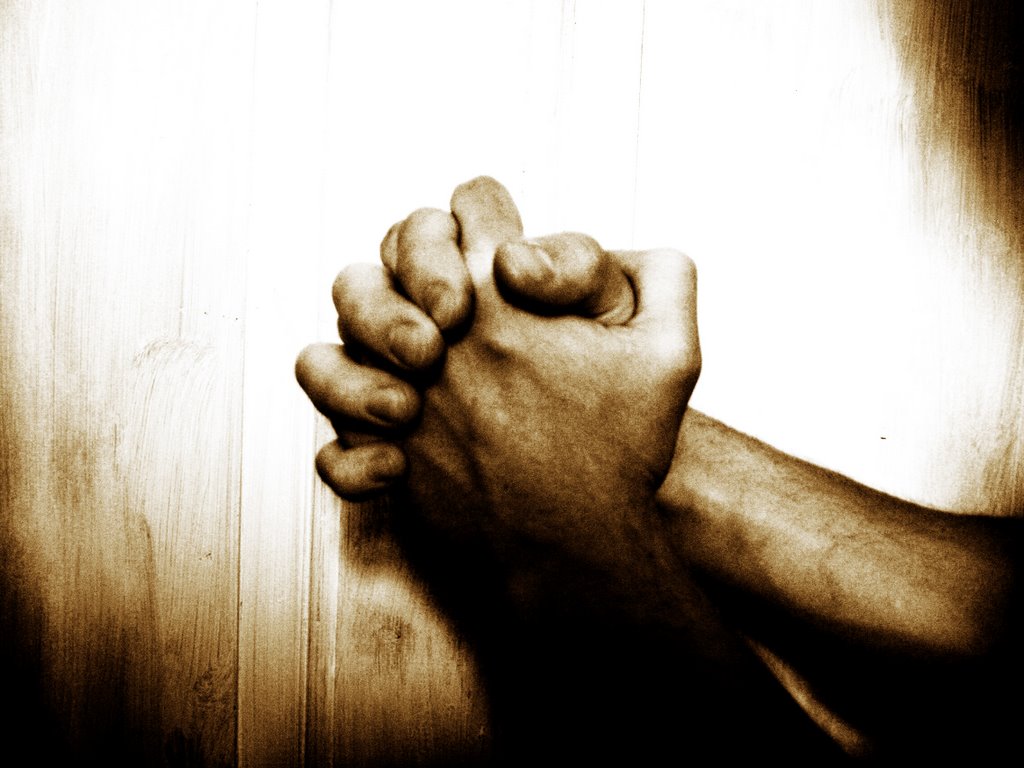
It is very apparent from the Word of God that he often tries the faith and patience of his people, when they are crying to him for some great and important mercy, by withholding the mercy sought for a season; and not only so, but at first he may cause an increase of dark appearances. And yet he, without fail, at last prospers those who continue urgently in prayer with all perseverance and ‘will not let him go except he blesses.’
Showing posts with label Prayer. Show all posts
Thursday, 28 February 2013
Keep Going
Labels:
Prayer
Saturday, 10 November 2012
Good Habits or Legalism
Some challenging words from John Piper on one lie about prayer that we're prone to believe:
But the hard truth is that most Christians don’t pray very much. They pray at meals—unless they’re still stuck in the adolescent stage of calling good habits legalism. They whisper prayers before tough meetings. They say something brief as they crawl into bed. But very few set aside set times to pray alone—and fewer still think it is worth it to meet with others to pray. And we wonder why our faith is weak. And our hope is feeble. And our passion for Christ is small.The Duty of PrayerAnd meanwhile the devil is whispering all over this room: “The pastor is getting legalistic now. He’s starting to use guilt now. He’s getting out the law now.” To which I say, “To hell with the devil and all of his destructive lies. Be free!” Is it true that intentional, regular, disciplined, earnest, Christ-dependent, God-glorifying, joyful prayer is a duty? Do I go to pray with many of you on Tuesday at 6:30 a.m., and Wednesday at 5:45 p.m., and Friday at 6:30 a.m., and Saturday at 4:45 p.m., and Sunday at 8:15 a.m. out of duty? Is it a discipline?You can call it that. It’s a duty the way it’s the duty of a scuba diver to put on his air tank before he goes underwater. It’s a duty the way pilots listen to air traffic controllers. It’s a duty the way soldiers in combat clean their rifles and load their guns. It’s a duty the way hungry people eat food. It’s a duty the way thirsty people drink water. It’s a duty the way a deaf man puts in his hearing aid. It’s a duty the way a diabetic takes his insulin. It’s a duty the way Pooh Bear looks for honey. It’s a duty the way pirates look for gold.Means of Grace: Gift of GodI hate the devil, and the way he is killing some of you by persuading you it is legalistic to be as regular in your prayers as you are in your eating and sleeping and Internet use. Do you not see what a sucker he his making out of you? He is laughing up his sleeve at how easy it is to deceive Christians about the importance of prayer.God has given us means of grace. If we do not use them to their fullest advantage, our complaints against him will not stick. If we don’t eat, we starve. If we don’t drink, we get dehydrated. If we don’t exercise a muscle, it atrophies. If we don’t breathe, we suffocate. And just as there are physical means of life, there are spiritual means of grace.
Labels:
Christian Life,
Prayer
Thursday, 11 October 2012
A Certain Desperation
Recently Justin Taylor interviewed Dale Ralph Davis, who's written a number of excellent Old Testament commentaries. One of the questions he asked him was about the role of prayer in Biblical interpretation. Davis gave a very helpful answer, and is equally applicable both to those who are preparing to teach the Bible to others and those seeking to read it for themsleves. Here is what Davis said on the role of prayer in Biblical interpretation:
There’s not much I can say here except that the temptation I run into is ignore it. I’ve been so happy to run into the following quotation from Owen:
For a man solemnly to undertake the interpretation of any portion of Scripture without invocation of God, to be taught and instructed by his Spirit, is a high provocation of him; nor shall I expect the discovery of truth from any one who thus proudly engages in a work so much above his ability.
I originally came across this quote in Richard Pratt’s He Gave Us Stories. All I can say is that’s where I have to come back to again and again. It is very easy for me to start in and pull the books off the shelf and so on and dive into the Hebrew text and not give even a thought to specific prayer about that. I’ve done that before and you’re in the middle of it and you think “Boy, what a Godless approach this is. Here I am dealing with syntax and interpretation and I haven’t even really sought the Lord’s face about it.” I know it is the proper thing to say—”you need to pray before you prepare”—but there needs to be a certain desperation about this which I’m not sure we normally have. Again, all I can really say is that I seek to catch myself in this area and repent and go back to that point and then start over again.
Labels:
Bible,
Gospel Work,
Prayer,
Preaching
Wednesday, 19 September 2012
A Praying Church?
Again there is the lack of prayer and of the Church praying. This is to me the most alarming, for this reason: we have built apparently strong, large, successful, active churches. But many of our churches never meet as a congregation for prayer. I mean never! What does that indicate we are saying about the life of the Church as a fellowship? By contrast, the mark of a truly apostolic spirit in the church is that that we give ourselves to prayer and the Word together (Acts 6:4). No wonder “the Word of God continued to increase and the number of the disciples multiplied” (Acts 6:7). If this is so, it should not surprise us that while many churches see growth, it is often simply reconfiguration of numbers, not of conversion. I greatly wish that our churches would learn to keep the main things central, that we would learn to be true Churches, vibrant fellowships of prayer, Gospel ministry and teaching, genuine mutual love. At the end of the day, such a Church simply needs to “be” for visitors who come to sense that this is a new order of reality altogether and are drawn to Christ.You can read the whole article here.
Labels:
Christian Life,
Church,
Prayer
Wednesday, 25 July 2012
Personal Prayer and Killing Sin
J. I. Packer writes: "The activity by which the Christian directly secures the mortification of his sins is prayer". What does this look like? In this helpful short video Packer unpacks further what he means by this.
Saturday, 28 April 2012
Pray for Your Prayers
Tim Challies has a helpful post on seven ways we can pray for our prayer lives. His seven points, each drawn from a particular Bible passage, are as follows:1) Pray that your prayers would be the expressions of a humble heart.
2) Pray that God would remind you that he doesn’t want or need your eloquent prayers.
3) Pray that you would remember what the really important requests are.
4) Pray that you would remember biblical examples of answered prayer.
5) Pray that God would give you confidence in his sovereign power.
6) Pray that God would help you to persevere in your praying.
7) Pray that God would encourage you that he is your loving Father and will give you only what is good.
You can read the whole article by clicking here.
Labels:
Prayer
Wednesday, 18 April 2012
Wednesday, 28 March 2012
Prayerful Parents
My father was a church planter in Québec, in the difficult years when there was strong opposition, some of it brutal. Baptist ministers alone spent a total of eight years in jail between 1950 and 1952. Dad’s congregations were not large; they were usually at the lower end of the two-digit range.
On Sunday mornings after the eleven o’clock service, Dad would often play the piano and call his three children to join him in singing, while Mum completed the preparations for dinner. But one Sunday morning in the late fifties, I recall, Dad was not at the piano, and was not to be found.
I finally tracked him down. The door of his study was ajar. I pushed it open, and there he was, kneeling in front of his big chair, praying and quietly weeping. This time I could hear what he was saying. He was interceding with God on behalf of the handful of people to whom he had preached, and in particular for the conversion of a few who regularly attended but who had never trusted Christ Jesus.
In the ranks of ecclesiastical hierarchies, my father is not a great man. He has never served a large church, never written a book, never discharged the duties of high denominational office. Doubtless his praying, too, embraces idioms and stylistic idiosyncrasies that should not be copied.
But with great gratitude to God, I testify that my parents were not hypocrites. That is the worst possible heritage to leave with children: high spiritual pretensions and low performance. My parents were the opposite: few pretensions, and disciplined performance.
What they prayed for were the important things, the things that congregate around the prayers of Scripture. And sometimes when I look at my own children, I wonder if, should the Lord give us another thirty years, they will remember their father as a man of prayer, or think of him as someone distant who was away from home rather a lot and who wrote a number of obscure books.
That quiet reflection often helps me to order my days.
Labels:
Prayer,
Saints of Old
Wednesday, 25 January 2012
The Supreme Expression of Our Faith
What does a faith-filled Christian look like? What is it that shows that a persons faith is in God, and that they are confidently trusting in all that He has promised?
Martyn Lloyd-Jones' answer is that a faith-filled Christian is a praying Christian. He sees prayer as the greatest expression of our faith, when he says:
Prayer, in many ways, is the supreme expression of our faith in God and our faith and confidence in the promises of God. There is nothing that a man ever does which so proclaims his faith as when he gets down on his knees and looks to God and talks to God. It is a tremendous confession of faith. I mean by this that he is not just running with his requests and petitions, but if he really waits upon God, if he really looks to God, he is there saying, ‘Yes, I believe it all, I believe that you are a rewarder of them that diligently seek you, I believe you are the Creator of all things and all things are in your hands. I know there is nothing outside of your control. I come to you because you are in all this and I find peace and rest and quiet in your holy presence and I am praying to you because you are what you are.’ That is the whole approach to prayer that you find in the teaching of Scripture.
Labels:
Prayer
Wednesday, 30 November 2011
"Do we wish to grow in grace?"
J. C. Ryle:
I confidently assert that the principal means by which most believers have become great in the Church of Jesus Christ is the habit of "diligent private prayer."
Look through the lives of the brightest and best of God's servants, whether in the Bible or not. See what is written of Moses, and David, and Daniel, and Paul. Note what is recorded about Luther and the Reformers. Observe what is related of the private devotions of Whitfield, and M'Cheyne. Tell me of one of all the godly fellowship of saints and martyrs, who has not had this mark most prominently--he was a "man of prayer." Oh, depend on it, prayer is power!
Prayer obtains fresh and continued outpourings of the Spirit. He alone begins the work of grace in a man's heart: He alone can carry it forward and make it prosper. But the Holy Spirit loves to be petitioned. And those who ask most, will always have most of His influence.
Prayer is the surest remedy against the devil and besetting sins. That sin will never stand firm which is heartily prayed against: the devil will never maintain influence over us when we ask the Lord to help us. But, then, we must spread out all our case before our Heavenly Physician, if He is to give us daily relief: we must ask Christ to send them back to the pit.
Do we wish to grow in grace and be very holy Christians? Then let us never forget the value of prayer.
Labels:
Prayer
Thursday, 20 October 2011
The Pride of Prayerlessness
There are many reasons for our prayerlessness - lack of time, lack of energy, the pressures of caring for a young family, lack of concentration. All of these are significant things that make the battle for prayerfulness a difficult one. However, I want to suggest that the battle goes much deeper.The battle against prayerlessness goes to the heart. At its heart our prayerlessness is not ultimately because we are disorganised or pressed for time. Rather, at the heart of prayerlessness is pride.
There are two major ways that prayerlessness reveals our pride, both of them are inseparably linked:
1) We have too high a view of ourselves
One of the reasons why we find it a struggle to pray is that we have too high a view of ourselves. One major way that this shows itself is our failure to see ourselves as helpless. We do not clearly see ourselves as a creature dependent upon our Creator. That is, we fail to recognise that we're utterly dependent upon God for all things.
This is pride. the reason we do not see ourselves as dependents is because we want to see ourselves as self sufficient. Essentially what this means is that we want to make ourselves God. Think about it. God is the only one who is completely self-sufficient and who depends upon nobody. He is the Creator who "gives to all mankind life and breath and everything." (Acts 17:25) Therefore, he is not "served by human hands, as though he needed anything." (Acts 17:25). He is the source of all life, therefore He is not dependent upon anybody of anything. If He was He would not be God.
When we try to see ourselves as self sufficient we are seeking to put ourselves in the place of God. We want to be those who have no need of anybody else. This is a denial of the fact that we are creatures, and a necessary part of our creatureliness is that we are dependent upon our Creator. When we seek to be independent we seeking that which belongs to God alone, we are seeking to enthrone ourselves in God's place.
It will be quite helpful for us to think awhile on Daniel 4. Nebuchadnezzar saw himself as self-sufficient, when he said "Is not this great Babylon, which I have built by my mighty power..." (Daniel 4:30). He prides himself on his power, on his ability to provide for himself. As soon as he says these words, God humbles him, making him like one of the animals of the field. He shows him just how dependent he really is upon God. God is the one who has given him this power and his kingdom. He is utterly dependent upon God. If this is true of the most powerful man in the world at the time, how much more is it true of us.
2) We have too low a view of God
A wonky view of ourselves will naturally mean that we have a wonky view of God. Our knowledge of God andour knowledge of ourselves are inseperably liked. If we change one we change the other. If we alter our view of oursleves, this will have profound effects on our view of God.
In light of what we've seen above this means that our prayerlessness stems from too low a view of God. If we don't come to Him as those who are utterly dependent upon Him for all things, what does this say about our view of God? Implicitly say that we do not recognise that He is the Creator upon whom we are dependent. Essentially it means that we try to de-God God. We try to make Him less than God.
Instead of seeing God as the Creator, this thinking tries to lower Him to the level of a Creature. By failing to depend on Him for all things we are implicitly denying that "from him and through him and to him are all things." (Romans 11:36). We are denying that He is all-sufficient, that all we need comes from Him. We are also denying His power, that He is able to give us all we need.
Where do we go from here?
"God opposes the proud, but gives grace to the humble." (James 4:6). Where we need to go from here is to humble ourselves before God. We need to recognise afresh who we are and who God is. He is the Creator and we are His creatures.
More than this, we need to recognise ourselves as sinners dependent upon His grace. We need to recognise our sinfulness in exalting ourselves over God, and dishonouring Him by denying His all-sufficiency. We need to bow humbly before Him saying with the tax collector: "God, be merciful to me, a sinner!" (Luke 18:13), and look to Him for forgiveness. We can do this with confidence because of the cross of Christ. He is the one who is the propitiation for our sins (1 John 2:2). Therefore, "[i]f we confess our sins, [God] is faithful and just to forgive us our sins and to cleanse us from all unrighteousness." (1 John 1:9).
The more we recognise who we and who God is are this the more we shall be humbled before God and forced to kneel before Him. Humility is the soil in which the flower of dependent prayer grows. The more we meditate on the greatness of God, which He has revealed to us in Scripture, the more we shall see ourselves in our proper place and be humbled. The more we are humbled the more naturally we will give ourselves to God-exalting prayer.
Labels:
Prayer
Thursday, 13 October 2011
Prayerlessness
Almost every believer I've spoken to admits that they find prayer a struggle. Many of us struggle to set aside more time to pray, and when we do pray we struggle with the fact that we find our prayers to be cold, and distracted. Why is this? J. C. Ryle puts his finger on one of the reasons when he says:Therefore, let us work hard at recognising the reality about ourselves, that we are creatures who are utterly dependent upon our Creator, sinners utterly dependent upon a gracious Saviour. The more we recognise our weakness and helplessness, the quicker and more urgently we will run to our Father's throne of grace in prayer.How is it that many true believers often pray so coldly? What is the reason that their prayers are so feeble, wandering and lukewarm, as they frequently are? The answer is very plain: their sense of need is not so deep as it ought to be. They are not truly alive to their own weakness and helplessness, and so they do not cry fervently for mercy and grace. Let us remember these things. Let us seek to have a constant and abiding sense of our real necessities. If saints could only see their souls as the ten afflicted lepers saw their bodies, they would pray far better than they do.
Labels:
Prayer
Wednesday, 3 August 2011
Prayer is Your Life
The following is another snippet from Adrian Reynolds' interview of Tim Keller at the Evangelical Ministry Assembly in London in June. Here Keller speaks about his prayer life, the vital importance of cultivating time for prayer and how he has done that. I have found his comments deeply challenging, as I seek to do the same.
Monday, 20 June 2011
One of the Best and Most Powerful Means of Advancing the Gospel
J. C. Ryle had these words to say about the part of every Christian in the work of the gospel globally:
Prayer is one of the best and most powerful means of helping forward the cause of Christ in the world. It is a means within the reach of all who have the Spirit of adoption. Not all believers have money to give to missions. Very few have great intellectual gifts, or extensive influence among men. But all believers can pray for the success of the Gospel, and they ought to pray for it daily. Many and marvelous are the answers to prayer which are recorded for our learning in the Bible. “The effectual fervent prayer of a righteous man avails much.” (James 5:16.)
Wednesday, 16 March 2011
How You Can Pray for Japan
Over at the Gospel Coalition John Starke has posted a report from a missionary in Japan. She gives a helpful and moving account of the state of things in Japan, the effect that the earthquake has had on the work of the gospel there, and how we can best be praying. One of the things which particulary struck me is her clear gospel shaped attitude to her work in Japan, she says:My unbelieving family say in “love” that I should leave Japan for the United States because I have some contacts there. They assume that our goal for life is to physically preserve ourselves. But we know that our true goal is to die to the idol of self-preservation, and to be raised into God’s preservation, which is destined to victory... [What my family] cannot understand or accept is the fact that I see and taste the happiness that is given through the atoning cross of Christ. I came to Japan to die to all my self-dignity to live for Christ who loves to rescue his enemies, who alone can make me filled with all that I could hope for and far more.You can read Starke's article by clicking here.
Labels:
Gospel Work,
Prayer
Monday, 14 March 2011
Praying for Japan After the Earthquake
In light of the earthquake and tsunami that have devastated Japan, we ought to be praying for that nation. At times like this we can often find ourselves at a loss as to what to pray. We know we ought to pray, but, in light of the great shock and sorrow, we can find it a struggle to find the words. Over at Desiring God John Piper has thought carefully in light of Scripture about how we might best pray for Japan in a way that is both glorifying to God and for the good of the people of Japan. He recently posted on his blog how he is praying for Japan. What he has written is both Bible-saturated and a great starting point for us as we seek to pray for Japan in light of the devastation of last week's earthquake. Here is Piper's prayer for Japan:
Father in heaven, you are the absolute Sovereign over the shaking of the earth, the rising of the sea, and the raging of the waves. We tremble at your power and bow before your unsearchable judgments and inscrutable ways. We cover our faces and kiss your omnipotent hand. We fall helpless to the floor in prayer and feel how fragile the very ground is beneath our knees.
O God, we humble ourselves under your holy majesty and repent. In a moment—in the twinkling of an eye—we too could be swept away. We are not more deserving of firm ground than our fellowmen in Japan. We too are flesh. We have bodies and homes and cars and family and precious places. We know that if we were treated according to our sins, who could stand? All of it would be gone in a moment. So in this dark hour we turn against our sins, not against you.There are a number of mission agencies with workers in Japan. In order to pray more informedly for Japan, its needs, and the work of the gospel there why not visit their websites. Both IFES and OMF have posted updates about the situation in Japan, news on their missionaries, and how to pray for Japan.
And we cry for mercy for Japan. Mercy, Father. Not for what they or we deserve. But mercy.
Have you not encouraged us in this? Have we not heard a hundred times in your Word the riches of your kindness, forbearance, and patience? Do you not a thousand times withhold your judgments, leading your rebellious world toward repentance? Yes, Lord. For your ways are not our ways, and your thoughts are not our thoughts.
Grant, O God, that the wicked will forsake his way, and the unrighteous man his thoughts. Grant us, your sinful creatures, to return to you, that you may have compassion. For surely you will abundantly pardon. Everyone who calls on the name of the Lord Jesus, your beloved Son, will be saved.
May every heart-breaking loss—millions upon millions of losses—be healed by the wounded hands of the risen Christ. You are not unacquainted with your creatures' pain. You did not spare your own Son, but gave him up for us all.
In Jesus you tasted loss. In Jesus you shared the overwhelming flood of our sorrows and suffering. In Jesus you are a sympathetic Priest in the midst of our pain.
Deal tenderly now, Father, with this fragile people. Woo them. Win them. Save them.
And may the floods they so much dread make blessings break upon their head.
O let them not judge you with feeble sense, but trust you for your grace. And so behind this providence, soon find a smiling face.In Jesus’ merciful name, Amen.
Tuesday, 22 February 2011
Four Posts on Prayer
Here are four selected posts from the "Above Every Name" archives to encourage and spur us on to "Continue steadfastly in prayer" (Colossians 4:2):
Labels:
Prayer
Monday, 7 February 2011
'My Noblest and Most Fruitful Employment'
Robert Murray McCheyne recognised just how crucial private prayer was for his Christian life and his ministry. In some notes, written towards the end of his life, called "Reformation in Secret Prayer" he says:
I ought to pray before seeing any one [in the morning]. Often when I sleep long, or meet with others early, and then have family prayer, and breakfast, and forenoon callers, often it is eleven or twelve o'clock before I begin secret prayer. This is a wretched system. . . . Family prayer loses much of its power and sweetness; and I can do no good to those who come to seek from me. The conscience feels guilty, the soul unfed, the lamp not trimmed. Then, when secret prayer comes, the soul is often out of tune. . . .
It is far better to begin with God—to see his face first—to get my soul near Him before it is near another. "When I awake I am still with Thee." If I have slept too long, or am going on an early journey, or my time is in any way shortened, it is best to dress hurriedly, and have a few minutes alone with God, than to give it up for lost. But in general, it is best to have at least one hour alone with God, before engaging in anything else. . . .
I ought to spend the best hours of the day in communion with God. It is my noblest and most fruitful employment, and is not to be thrust into any corner. The morning hours, from six to eight, are the most uninterrupted, and should be thus employed, if I can prevent drowsiness. A little time after breakfast might be given to intercession. After tea is my best hour, and that should be solemnly dedicated to God, if possible. . . . [And] when I awake in the night, I ought to rise and pray, as David and as John Welsh did.
Labels:
Prayer,
Saints of Old
Thursday, 6 January 2011
A Spiritual Cardiograph
What should the Christian life feel like? What ought to be the emotions and affections that we have as a Christian from day to day, and as we face the different circumstances that life brings our way? This is an important question to think through. The problem is that we don't feel as we ought to feel, we don't desire what we ought to desire, we don't delight in what we ought to delight in, we don't weep over what we ought to weep over. Our affections, desires and feelings are disordered. Sin has affected every part of who we are. This does not mean that we are as sinful as we can be, in His grace God restrains us from this. However, it does mean that there is no part of who we are that is unaffected by sin. Therefore, not only have our actions and our thoughts been tainted by sin, so also have our emotions, desires and affections. All of our person has been impregnated by sin, it has marred the whole of who we are. This is why we find ourselves getting exited by things that are sinful, and being bored with things that are pleasing to God.
What then can we do in order to feel as we ought to feel? How can we re-order our affections and emotions? The way we do this is to allow our desires and feelings to be shaped by Scripture. One of the parts of Scripture that God has provided in particular for this is the Psalms. They both reveal how healthy our emotions and affections are, and help to re-calibrate them so that we feel the way we ought to feel.
Recently I came across these words from a former pastor of mine: "It has been wisely said that the Psalter is a spiritual cardiograph. The more I am at home in the Psalms, the healthier my spiritual condition." That is, the Psalms show us the state of our hearts. They help us to see how healthy our feelings and longings are. The more we read through them the more we see what affections and emotions shaped by the truth of God's word look like. The more we see of this the more clearly we will be able to diagnose how healthy our desires and emotions are.
Another great function of the Psalms is to shape our distorted feelings and desires so that we begin to feel as we ought to feel, delight in what we ought to delight in and weep over what we ought to weep over. Christopher Ash says: "The Psalms give us authorised, authentic response to God and his word." They re-calibrate our emotions so that they are shaped by God's word. This is because the Psalms not only teach us truth about God, they also take that truth and turn it into prayer, they show us how we ought to respond to God's word. One of the things the Psalmists do throughout the book of Psalms is to take the rest of Scripture and turn it into prayer. They show how we ought to respond to the rest of the Bible. In doing so they are re-ordering our ragged desires and emotions so that they are brought more in line with the truth of God's word.
This means that, if we want to feel the way we ought to feel, one of the best ways we can do this is to learn to pray the Psalms. Take them and make them our prayers. One of the ways I have tried to do this is to try and pray through a Psalm a day. Why not try making the Psalms more a part of your prayer life (both private and corporate). Take a Psalm, read it and then turn it into prayer. Let what the Psalmist delights in become what you delight in, let what he mourns over be what he mourns over, let what he longs for be what you long for. The more we do this the more we find that we will become aware of how we ought to feel, and we will find that our affections and emotions become increasingly shaped by the truth of God's word.
Labels:
Bible,
Christian Life,
Prayer
Thursday, 2 December 2010
"Attaining the knowledge of the mind of God in the Scripture"
In a previous post we saw our need to be sweating over the text in dilligent study as we seek to understand and apply Scripture. However, we must not neglect our need to also be sweating over the text in prayer. If we are merely working hard with the text and neglecting to wrestle with God in prayer that He might open our eyes to see the glorious truths of His word then we cannot expect to understand it. This is what John Owen recognised. Listen to these words: I suppose ... this may be fixed on as a common principle of Christianity; namely, that constant and fervent prayer for the divine assistance of the Holy Spirit, is such an indispensable means for ... attaining the knowledge of the mind of God in the Scripture, as that without it all others will not [avail]. (Works, IV, p. 203.)
Labels:
Bible,
Prayer,
The Holy Spirit
Subscribe to:
Posts (Atom)